

Learn about the best root killer for trees. Trees are beautiful and they offer many benefits for your yard and landscape: shady canopy of leaves, a bit of privacy, and a habitat for friendly wildlife.
However, at times, trees can be a headache to deal with when their growth encroaches on other parts of your property.
Their roots can become invasive, damaging sidewalks, driveways, and even underground utility lines. In some cases, tree roots can invade plumbing systems, leading to costly repairs and plumbing blockages.
Choosing the best root killer will help address these issues without harming the rest of your yard or the surrounding environment.
It’s important to select a product that aligns with your needs, whether it’s a chemical solution for rapid results or an organic option for eco-friendly control.

Common Issues
- Tree roots grow into pipes and drains, causing breakage and dangerous leaks. This leads to smelly messes and costly repairs that can decimate your yard.
- Branches can grow out beyond your property lines, into neighbors yards or nearby power lines.
- Tree limbs can break and cause property damage.
In fact, some homeowners choose to remedy this problem simply by removing the tree entirely. Once the tree has been removed, however, that doesn’t mean the problems are gone for good.
Deep below the ground, tree roots still grow and can pop up in one or many spots through out your yard. When this happens, you have to deal directly with the root system to prevent further damage. This means homeowners need to know the best root killer for trees.
A Few Remedies:
- Stump Grinding
- Herbicides
- Salting the Stump
Stump Grinding
First, grinding down your tree stump is the fastest method of removing the stump and killing the root system. A stump grinder is a power tool that removes tree stumps with cutting disc that chips away the wood.
This method is typically thorough enough to stop further growth below the surface, thereby preventing root-based problems in the future.
Herbicides for killing tree roots
Moreover, one of the best root killers for trees is a commonly used herbicide called Round-Up (glyphosate).
To apply herbicide to a tree stump, drill a series of 6-inch-deep holes around the edge of the stump using a 1-inch spade bit extension. Apply with a small paint brush.
The roots will die out, killing the stump in the process.
If you’d rather not use a systemic herbicide such as glyphosate, vinegar is an effective organic alternative. The one drawback is that it will take multiple applications to kill the roots.
Select a warm, dry day and fill a spray bottle with undiluted white vinegar and spray thoroughly. Coat the leaves of any shoots growing back from the tree roots and stump.
This added measure destroys the leafy top-growth that supplies the roots with food. The root system will eventually die off as well.
Salting Stumps can kill tree roots
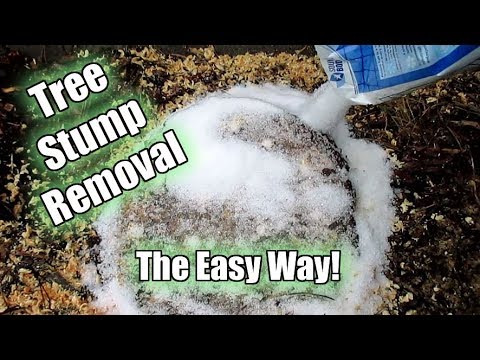
Furthermore, epsom salts acts as a weed killer by absorbing water that would normally be used by plant roots. Salting plants and roots creates a drought-like condition that deprives vital water to the root system.
Another component of this process is in the aftermath of the absorption of salt by the water in the ground. Once it’s taken in by the tree’s roots, the epsom salt will build up to a toxic level within the plant.
While this is a highly effective way to kill off a problematic tree stump and its root system, keep in mind that its effects can harm nearby vegetation as well. Be sure to target the tree stump specifically, avoiding any spillage onto the surrounding grass.
Please check out the video below. You can watch part two here.
Wrapping Up

T. Stafford
Writing about gardening, lawn care, etc. to share what I've learned with others. I've lived in Texas my whole life, so I'm more familiar with this region's native plants.
Comments (5)
Great tip! I’m headed to the hardware store to get a drill bit.
we just cut large tree down, stump has been grinded down, now we have large roots to kill. What is the best killer for roots in the ground? The only products I am finding is stump killer and root killer for drains. I need a root killer for large roots in ground. Please help. Thank You
how to kill tree roots from neighbors tree. growing into gas and waste lines. as well as under my drive
Great info…I have been researching an inexpensive means of getting rid of this tree stump and killing the roots. It really helped me to know what type of drill/bit to buy. Us girls don’t automatically know these things. Seeing the actual process on video played out the directions so much better than just reading it. I’m in VA their Co-op didn’t have anything on the website that helped. So thank you for coverage on the subject.
Looking for a way to permanently keep tree roots from getting under and heaving my sidewalk. Would a barrier trench 3 feet deep and 4 inches wide filled with washed sand stop the roots. Possibly add a herbicide to the sand?